


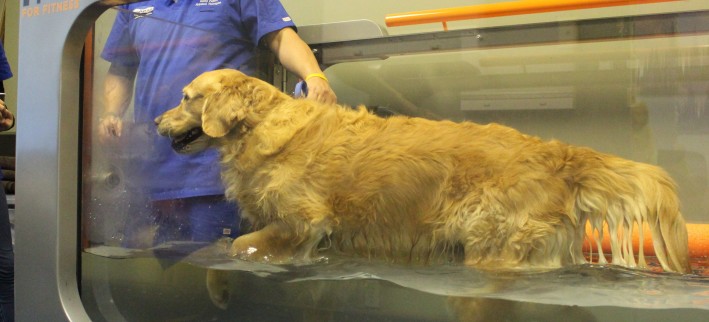
We offer on-site Animal Rehabilitation (similar to human physiotherapy) sessions with the goal of improving the quality of life for your pet by enhancing their recovery from orthopedic and neurological conditions, reducing and managing chronic pain and promoting health and wellness.
Hydrotherapy
During the recovery from surgery or traumatic injury, a full range of limb motion may not always be possible on land. The careful use of hydrotherapy after surgery or injury can be extremely beneficial for dogs, increasing their chance of a successful return to normal function.
Hydrotherapy acts by encouraging a full range of motion in reduced weight bearing conditions, thus improving muscle tone and promoting tissue repair. The buoyancy of the water reduces stress on the joints, creating a much safer environment for recovery after surgery or injury without imposing undue stress on damaged tissues.
The warm water increases the circulation of the blood to the muscles, thus increasing the supply of oxygen and nutrients. As the blood circulation increases, it flushes away the waste products leading to muscle relaxation and reduction in pain and stiffness. Improved circulation also reduces swelling around an injured area and enhances healing. The hydrostatic pressure of the water reduces swelling of the limbs. The perpendicular jets apply pressure in all directions, resolving the edema in the distal portions of the body while the patient exercises.
The BBVSH Underwater Treadmill:
- Allows observation by rehabilitation staff from all sides
- Allows early rehabilitation for spinal injury/surgery patients
- Water height can be adjusted to optimal weight bearing level
- Speed and duration can be adjusted to achieve optimal gait
- To add more challenge for fitness, the treadmill can be inclined and equipped with jets for increased resistance
Hydrotherapy has specific effects on the body:
- Relief of pain, swelling and stiffness
- Increased joint range of motion
- Increased tissue healing
- Increased speed of recovery
- Stability and balance
- Improved circulation
- Improved muscle patterning and recruitment (extremely important for spinal injury dogs learning to walk again
- Prevent secondary complications as a result of limb disuse, muscle contracture, gait abnormalities
- Assist in earlier return to normal life or work (especially important for assistance or police service dogs)
- Improve quality of life (especially for older or disabled dogs)
Conditions that benefit from hydrotherapy:
Dogs that require improvement in: core strength, gait modification, flexion, extension, proprioception, muscle bulk, cardiovascular and muscle endurance will benefit from hydrotherapy including those with:
Pre and Post Surgical Cases
- Cranial Cruciate Rupture (TTA, TPLO)
- Arthroscopy
- Patellar Groove Replacement (PGR)
- Proximal Abducting Ulnar Osteotomy (PAUL)
- Total Hip Replacement (THR)
- Femoral Head Osteotomy (FHO)
- Bone Fracture Repairs
Neurological conditions
- Intervertebral Disc Disease
- Spinal Injury/Trauma/Shock
- Cervical Vertebral Malformation
- Neuromuscular Disease
- Degenerative Myelopathy (DM)
- Peripheral Neuropathies
- Spinal Stenosis
Developmental Conditions
- Hip and Elbow Dysplasia
- Patellar Luxation
- Osteochondrosis Dissecans (OCD)
Soft Tissue Injuries
- Tendinitis
- Ligament Sprain
- Tendinopathies
- Muscle strain
Obesity
Canine obesity is dangerous because it can lead to a great number of health problems. It may also adversely affect an existing health issue. The following diseases and disorders may be caused or exacerbated by obesity:
- Cardiac disease
- Diabetes Mellitus
- Hypertension (high blood pressure)
- Orthopedic injuries (such as cruciate ligament rupture or patellar luxation)
- Osteoarthritis
- Respiratory disorders
- Various forms of cancer
Conquering Canine Obesity
involves establishing goals, tailoring exercise programs and examination of diet in order to safely reduce body weight, improve body condition and move towards a sustainable long term healthy lifestyle. Contact our Animal Rehabilitation Services for more information.
Laser Therapy
Non invasive therapy for pain relief and faster healing. Laser therapy involves driving energy derived from light into the target area stimulating tissues at the cellular level. The metabolism of the cells, are stimulated to accelerate healing time and provide pain relief through the release of endorphins.
Canine Massage
a gentle superficial massage is indicated in order to increase local circulation and warm tissues to minimize pain associated with stiffness prior to exercise. Realignment of damaged tissues when stroked in direction of muscle fibers. Effective to relax the patient in preparation for other treatments
Therapeutic Exercises for Dogs
Therapeutic exercises are designed to encourage affected limb use for those patients reluctant to use a limb post surgically. The principle objectives are to build muscle strength and increase the range of motion, facilitating the return to normal function for orthopedic/neurological conditions.
Cold Thermotherapy
- use of superficial cold source applied to remove heat from an affected area
- causes vasoconstriction and slows metabolic rate of tissue reactions, reducing inflammation, swelling and pain
- most effective in acute inflammatory phase following tissue trauma
- may also be used during later healing stages to minimize inflammation following rehabilitative exercises
Warm Thermotherapy
- use of superficial heat source to apply heat to an affected area
- enhances the healing process by increasing local circulation and metabolic rate of tissue reactions (increased rate of delivery of nutrients to and waste products from affected tissues)
- may be used to warm tissues prior to exercise or stretching (heat increases extensibility of tissues allowing for greater flexibility and more effective stretching)
Electrical Stimulation for Dogs
Electrotherapeutic Modalities involves the use of electrical currents to accelerate healing, slow muscle atrophy and build muscle mass during periods of inactivity
Neuromuscular Electrical Stimulation
- application of electrical currents via electrodes to elicit muscle contractions
- delays muscle atrophy in non-ambulatory patients, facilitates neuromuscular reeducation, promotes muscle strengthening and sensory awarenessTranscutaneous Electrical Nerve Stimulation
- application of electrical current via electrodes for the purpose of pain control
- gate control theory of pain argues that a low-level constant stimulation of nocioceptor fibres that are sensitive to vibration interferes with other nocioceptor fibres responsible for communicating pain sensation to the brain resulting in decreased pain sensation
